
By Max Milano (Travel Writer & Photographer)
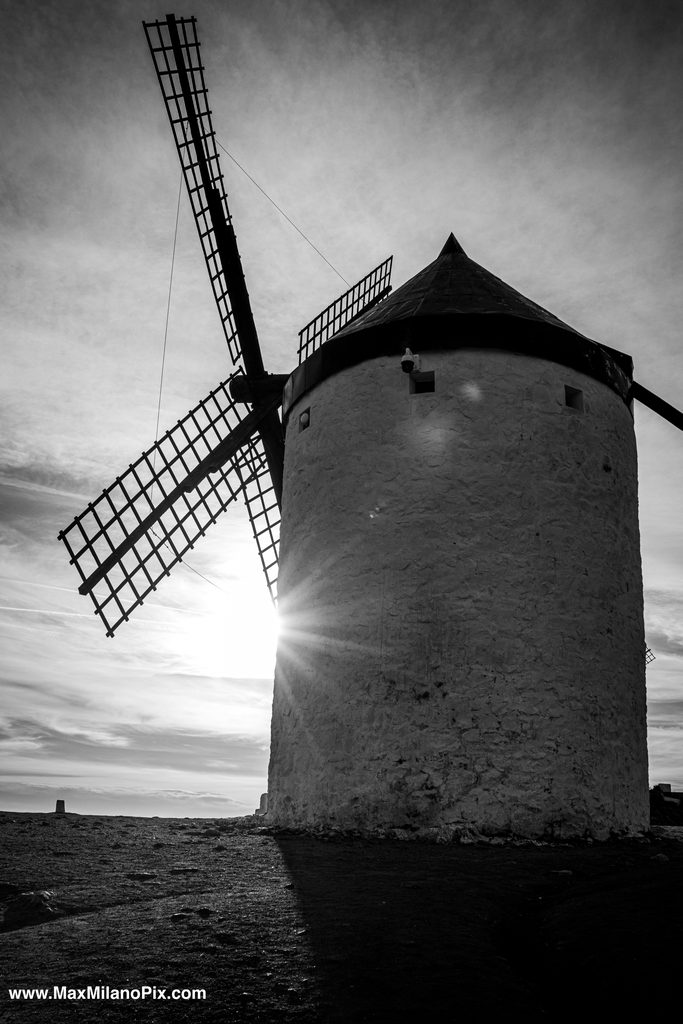
It’s a crisp, cold January morning in La Mancha, and the sun is just starting to peek over the dry, rusty hills beyond the whitewashed village below. I’m on a ridge crested with windmills and crowned by an old Moorish fort. Suddenly the sun’s rays break out from over the hills and illuminate the landscape, giving the whitewashed windmills a dreamlike look. You can almost see Don Quijote galloping uphill on Rocinante, pointing his lance at the windmills’ sails until the angry giants’ arms, in his crazy mind, sweep him up into the air and over the top, Rocinante and all. Or so Cervantes describes it early in his classic book Don Quijote, Part I. But as I stand on that ridge of windmills over the village of Consuegra in the dusty plains of La Mancha, something feels off. The hill feels too steep for poor old Rocinante to gallop up, too steep for portly Sancho Panza to chase behind Don Quijote on a donkey. Could this really be the place that Cervantes imagined? The Consuegra tourist board seems to think so, and it is a gorgeous, dramatic place, especially at dawn and in the crisp cold of a Manchego January. But is it the real place? Cervantes never says exactly where his mad hidalgo was from, apart from the vague opening lines of the book: In some place in La Mancha that I do not want to recall. A place best forgotten, but at the same time a place of this place, of La Mancha, the stain, a high desert plateau, 2,000 feet above sea level, cold in winter and blazing hot in summer, where clusters of whitewashed villages have been eking out a living off the rustic land, rearing sheep, tending vineyards, keeping hogs, much like the Romans did 2,000 years ago.
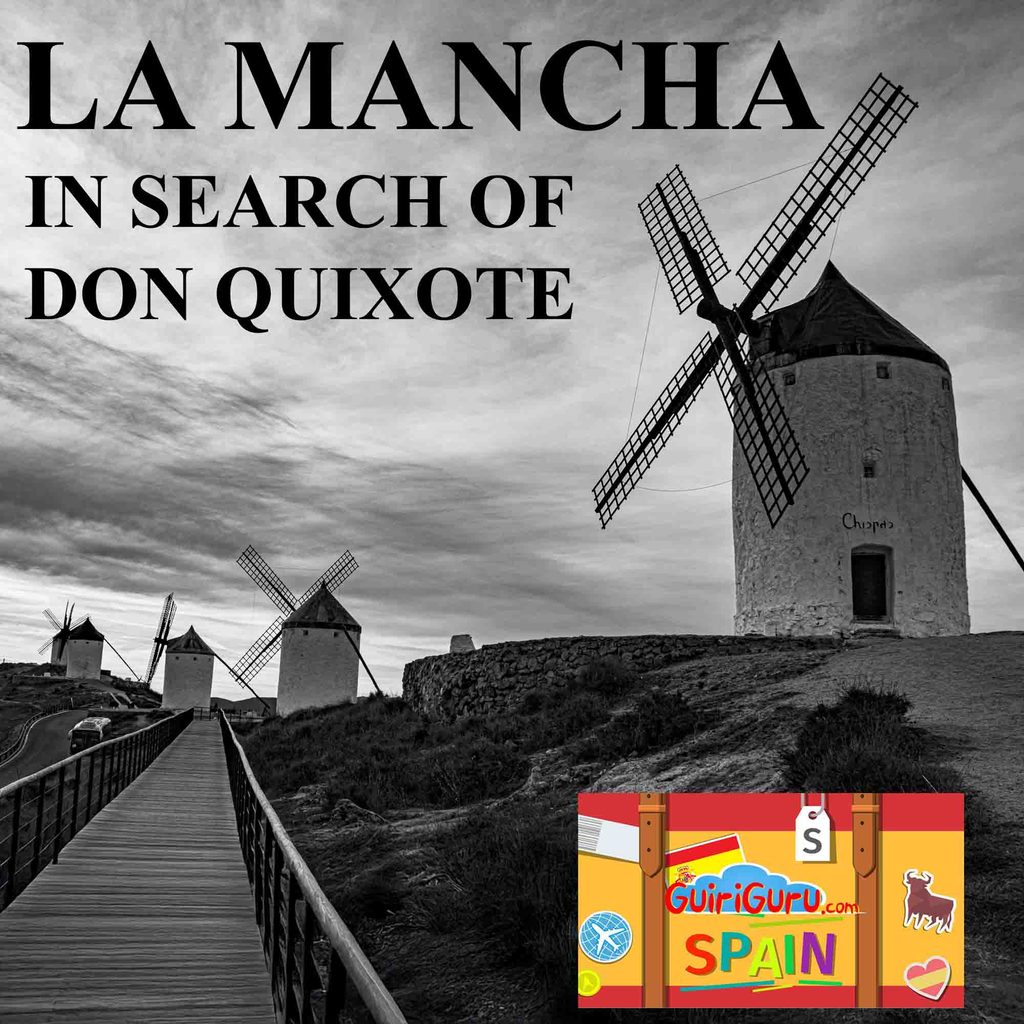
But which town begat Don Quijote? Cervantes never says because he wanted to forget La Mancha, which is strange, considering that he wanted to forget it and not Algiers, where he was imprisoned for several years after the Battle of Lepanto by Barbary Coast pirates. Cervantes also predicted that the villages of La Mancha would someday lay claim to Don Quijote for themselves, and now, as it turns out, they also lay claim to Cervantes’ birthplace.
Alcalá de Henares: The Official Story
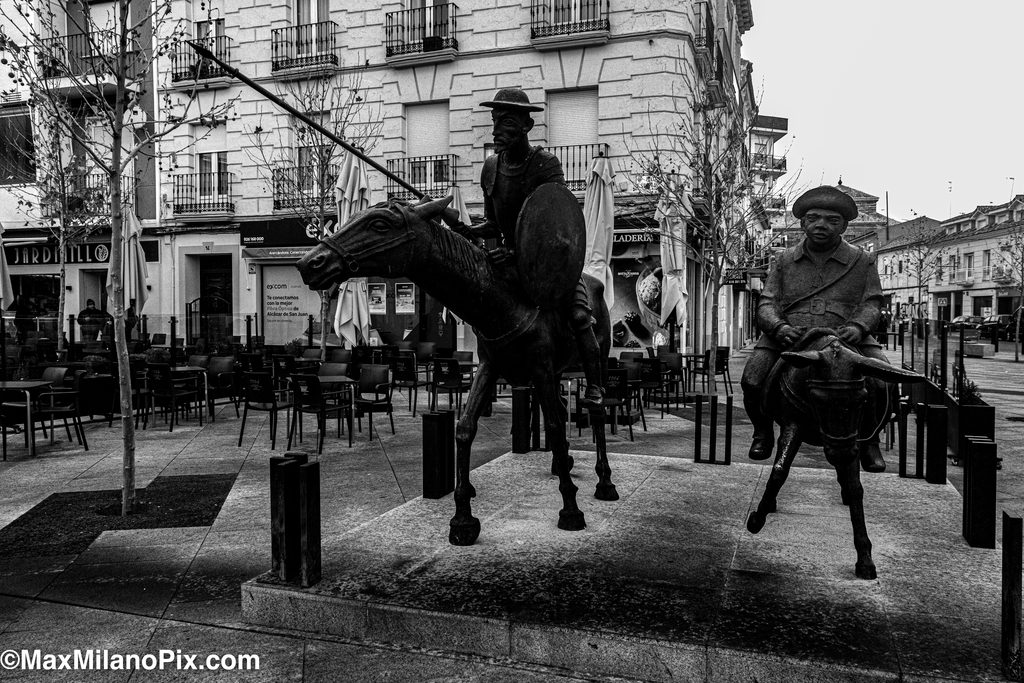
We’re sitting on a bench next to a pair of statues in front of a large medieval house in Alcalá de Henares. We’re in the middle of a pedestrian boulevard that has many narrow bifurcations, in what used to be the heart of the Jewish quarter until Queen Isabella began her pogroms. The statues sitting with us on the bench are none other than those of Don Quijote and his loyal esquire Sancho Panza, and the house across the way is what historians say is the official birthplace of Cervantes. The large size of the house and its location smack in the middle of the old Jewish quarter raise questions in my mind. Was Cervantes’ family wealthy enough to afford such a house at the time of his birth, and why inside the Jewish quarter? Were they really a family of Marranos, as the local gossip claims, i.e., converted Jews who hung ham hocks in their larder for appearance’s sake while keeping secret passages in their house that led to a secret room with a menorah?
Given that Cervantes is known as the Spanish Shakespeare, and the fact that both men lived at the same time and died on almost the same day (the same date but on different calendars, Gregorian vs. Julian), Shakespeare, like Cervantes, came from an artisan’s household, a glovemaker in Shakespeare’s case and a surgeon in Cervantes’. But surgeons in Cervantes’ time weren’t the revered, highly skilled professionals that they are today; back then, the profession was more akin to that of your local barber, perhaps the origin of Don Quijote’s odd hat, a barber’s basin. Was Cervantes skewering his own father?
Crypto-Jewish? Crypto-Catholics? What is it about family secrets that becomes fodder for great writers? And not just any writers. Cervantes, like Shakespeare, coined many new words in the Spanish language, Castilian, at a time when Castilian was on the cusp of entering its Golden Age and Latin still dominated the monasteries, universities and daily Mass, and memories of Mozarabic, the Latinized Arabic of the Moorish period spoken by the conquered Christians, were still recent in the books and histories of the era.
Some famous words coined by Cervantes in Don Quijote are Baciyelmo, combining Bacía (a barber’s basin) and Yelmo (helmet), referring to Don Quijote’s quirky hat that he insists is not a barber’s basin but a knight’s helmet; Asnalmente, “in a donkey-like manner,” usually aimed at Sancho Panza; and Bachillear, or to talk or argue like a bachiller, an educated man, with the suggestion of showing off one’s learning, something Don Quijote does to Sancho throughout the entirety of the book, exposing his true character as a member of the out-of-touch hidalgo class that Cervantes was skewering.
Alcalá de Henares has laid claim to being Cervantes’ birthplace, but it’s too grandiose and too beautiful to be the birthplace of Don Quijote, let alone the hometown of this hidalgo of much-diminished circumstances, surrounded by salt-of-the-earth peasants and quirky neighbors. Alcalá’s monasteries and palaces are too grandiose; one can imagine bishops and counts there, but not the cast of quirky peasants full of the salt-of-the-earth wisdom of Sancho Panza in a place like Alcalá de Henares. For that, we must leave the vicinity of Madrid and venture into the dry heartland of La Mancha, where nothing much happened back then and nothing much happens today, and which Cervantes wanted to forget so much that he wrote the world’s first modern novel about it.
Alcázar de San Juan
It’s an icy January morning, and we’re driving south from Madrid in the rain through the flat, dry nothingness of Castilla-La Mancha. Small, whitewashed villages dot the landscape here and there, with Quixotic windmills looming in the distance. We had left the snow-covered mountains to the north of Madrid and were now facing the long, boring drive to the coast, where nothing really happens to the landscape until you leave the high desert and begin to drop dramatically for over 2,000 feet to the Mediterranean Sea at the Valencia border. But we’re far from the Valencia border right now, and we’re hungry and tired and looking into the distance for a village in La Mancha that may have restaurants open. Finding a place to eat in these Manchego villages is not a given; we’ve been through this before on our drives south to Valencia from Madrid, getting off the freeway to explore a village only to find it completely deserted, most of the locals shut in from the cold or the heat. We see a sign for Alcázar de San Juan. The village is a ways from the freeway, but its cluster of white houses and red tiles looks promising. We’ve been playing the audiobook of Don Quijote since we got on the road; it provides a perfect soundtrack to our travels through La Mancha, filling the boring drive with Cervantes’ slapstick comedy and the sad image of this mad knight-errant roaming the dry landscape in search of adventure and only succeeding in harassing shepherds and innkeepers.
We park in the town square and are greeted by a pair of equestrian statues depicting Don Quijote and Sancho Panza heading boldly onto the Manchego plain. Don Quijote looks determined and fueled by madness, convinced of his righteousness. A quick Google search informs us that this very town that we’d picked at random from the freeway lays claim to being the place where Cervantes was baptized and even makes a bolder claim: they claim to be the real birthplace of Cervantes himself and the real location that inspired the town where the fictional Don Quijote lived and mingled with a coterie of weirdly charming locals. Bold claims, so we set out to explore the town and get to the bottom of the Cervantine myth, but it’s January in La Mancha, rain is falling horizontally, and it’s close to freezing, so no one is about and everything is closed. So we do what we always do in these small villages: we walk around aimlessly.
Cobblestone streets and narrow alleys drive us in circles until we end up in a small triangular plaza with an obelisk and a plaque on the wall that says: In this house Miguel de Cervantes, author of Don Quijote, was born in the year of our Lord 29 September 1547. Bold claims indeed! We’ve just been in Alcalá de Henares and sat across from Cervantes’ supposed birthplace, Quixotic statues included. So, which is it? Was grandiose Alcalá de Henares the real birthplace of Cervantes? Or this half-forgotten village in the middle of the Castilian plain that seems to have popped right out of the pages of Don Quijote? Even its opening line: In a place in La Mancha which I wish to forget. Is this the town that Cervantes forgot?
A few steps from the so-called Cervantes Square, we run into the Casa del Hidalgo, the hidalgo’s house. It’s a rather grand manor house, typical of the landed gentry in La Mancha during Cervantes’ time. If Don Quijote were a real hidalgo, he would have lived in a house like this, with a large front door, tall enough to enter on horseback, with stables out back and a wide interior courtyard flanked by rooms and an outdoor kitchen, a two-story Elizabethan-era version of a large Roman domus, minus the frescoes and tiles and floor heating, all replaced by adobe and dark wood and heavy, dark paintings. But alas, the house of the hidalgo is also closed. So, we press on.
A Church, A Statue and A Sacristan
Urged on by the cold rain and pangs of hunger, we continue down narrow, cobblestoned streets until we reach a plaza where a statue of Cervantes stands in a splendid pair of Elizabethan-era puffling pants, looking like a character right out of Upstart Crow. Behind the statue stands a medieval Moorish tower that looms above a small church, La Colegiata de Santa María la Mayor, according to the sign.
We approach the statue to admire Cervantes’ puffling pants, and we must have had a look of sad disappointment at finding both the church and the Moorish tower closed, because after a few tentative looks, a man who was loitering outside the church approached us and introduced himself as its sacristan and asked if we wanted to see Cervantes’ baptismal font. Of course! As it turns out, this is the church that lays claim to the baptismal chapel of Cervantes himself.
We accept, more to get out of the rain and the cold, never imagining the treasures enclosed inside the modest-looking church.
The middle-aged sacristan, bubbly and tanned, dressed in jeans and a polo top, leads us into the church via a side door, directly into the sacristy, i.e., the backstage of the church, replete with priests’ vestments and silver chalices for Holy Communion, only that this sacristy has a glass floor above a Roman-era cellar. We stand on the thick glass and look down in awe at the mosaics of a Roman temple that stood in this very location 2000 years ago.
We follow the sacristan into the main nave of the church as he points out the different chapels that line the walls. These go back to the Middle Ages, when each prominent family in the region would have its own private chapel along the walls of the church. At the back end, we reach another small chapel with a baptismal font in the middle and a plaque announcing the location of Cervantes’ baptism.
“A monk doing research some time ago found the baptismal records of this church and found the name of Cervantes Saavedra as being baptized here,” the sacristan tells us with a beaming smile, “but of course we all knew that Cervantes was from here. They only say that he was born in Alcalá de Henares because they wanted someplace near Madrid to claim him, but everyone in the town knows Cervantes was born here, was baptized here and based Don Quijote on local people from this town. Dulcinea herself lived just a few kilometers away in the next village over, and the famous windmills, they are not the ones up on the hills in Consuegra, but in a field not far from here. We know because Cervantes describes in the book how long it took for Don Quijote and Sancho to ride from here to the windmills at a Castilian horse’s pace, leaving at dusk and arriving at dawn, and the windmills out in Campo de Criptana are the only ones that fit the bill.”
He was a wonderful raconteur, quoting entire passages of Don Quijote like they were scripture.
Leading us up to the nave, the sacristan leads us into a small room where the church’s Virgin lives. The room is small but covered in silver offerings to the Virgin, who looks like a Greek goddess and is the real deity of the church, Jesus being relegated to the small chapel below. In Spain, Christianity is really the cult of virgins, just like the vestal virgins of Roman times.
Campo de Criptana
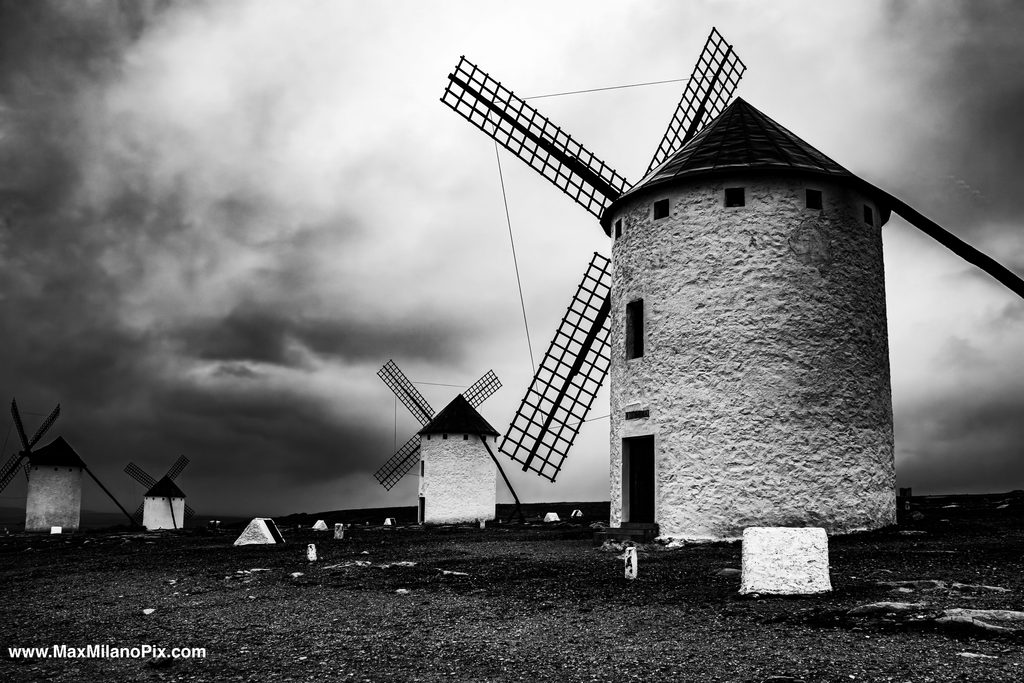
It’s raining cats and dogs by the time we arrive at Campo de Criptana. The famous windmills are here, whitewashed against a blackened sky. We’re playing the Don Quijote Part II audiobook and reaching the end, and we’re crying together with Sancho Panza when his master realizes he had been crazy all that time, but too late to do anything about it. A greyhound runs around the windmills in the freezing rain, bringing to mind the opening pages of Don Quijote. I think of a novel I should write set between books one and two of Don Quijote, where Don Quijote makes it to the New World on a conquistador ship and goes on adventures up in the high desert of Teotihuacan and runs into Cortés as he arrives at the foothills of stratovolcanoes near Puebla, only to find Don Quijote like an Elizabethan-era Kurtz, gone all Heart of Darkness with the Mexicas, and Sancho is running his own island on Lake Texcoco as governor and eating salamanders and running a harem of Indian women. Because Don Quijote’s madness is the same madness that fueled Cortés and Pizarro and all the hidalgos turned conquistadors, and reading Don Quijote is the best way to understand their folly. If only they, like Don Quijote, one day, perhaps not until their deathbeds, realized the extent of their madness.
Stay tuned to GuiriGuru for more Spain explorations and expat tips.
Max Milano is a travel writer and photographer based in Los Angeles, California, and Valencia, Spain. His latest photography book, Mexico City Noir, Life Under The Volcanoes, is Available on Amazon. His photographs are available at MaxMilanoPix.