
By Max Milano (Travel Writer and Photographer)
This is part five of a six part El Camino de Santiago Roadtrip. You can read the rest of the chapters here.
Hanging around Santiago de Compostela, surrounded by unenthusiastic pilgrims completing their camino by feebly posing for social media posts, was getting me down. So we decided to head out to Cape Fisterra, the end of the earth as the Romans thought. Only later did we learn that it isn’t even the westernmost cape in the Iberian Peninsula (that’s in Portugal) nor the westernmost point in Spain (that honor belongs to Cabo Touriñán, north of Finisterre). But we didn’t let these small facts curb our enthusiasm for visiting what the Romans once saw as the edge of the world.
The road from Santiago de Compostela to Cape Fisterra is both dull and spectacular, winding through small, sad villages and high mountains with ocean views on both sides. As the road began to descend into the town of Finisterre, we were greeted by gorgeous bays of azure water and powdery sand, and impossibly cute fishing villages brimming with tourists. We arrived at the cape to a traffic jam, but somehow found parking. The place was packed, but the view from the lighthouse was worth it. You could almost feel the Iberian Peninsula turning south beneath you. The coast stretching away toward Portugal in a chain of inlets and capes, jewels jutting into the blue.
For the first time since we’d begun this trip so many weeks ago, the sun was facing directly west over the water, and it brought back flashbacks of Los Angeles, where the sun always sinks into the Pacific when you’re standing on the beach.
There’s a restaurant and a coffee shop at the cape, so we secured a table overlooking cliffs and ocean and drank cold draft beers and foamy cortados. It was one of those impossibly beautiful August days in a usually foggy land. We sat there looking at each other with the quiet melancholy that comes when you realize summer is slipping away. My wife welcomed the thought; she had already begun romanticizing winter and fog because it reminded her of the beaches of San Francisco and her childhood in Ireland, where it rains in June. I, on the other hand, wanted to stretch the sunshine as long as I could. I was happy to see that bright western sun hover above an endless ocean as we sat on the last cliff in Spain before the vast Atlantic.
We began to get hungry, so we asked about a table at the restaurant by the lighthouse, but there were none available without reservations. It’s practically impossible to get fed in Spain during a road trip in sit-down restaurants, because people eat at odd hours, and when places open, they get instantly packed. You have to plan ahead, which we try not to do.
We left the cape and drove down to the fishing village below, parking on the beach where we found a restaurant housed in an old stone building. It had a Michelin Guide mention, but once again, no tables without reservations. So we made do with a glass of local white wine, which we drank while sitting on an overturned fishing boat, contemplating the sand and the impossibly blue water. It was a beautiful spot, a long bay flanked by low hills and houses dotting the shrub-covered slopes. We amused ourselves with people-watching and wondered how we were ever going to get fed in this country without reservations.
Ferrol
We arrived in Ferrol around six in the evening. Proper sit-down restaurants in Spain don’t open until eight or even eight-thirty, and we’d already missed lunch, so we were starving. After parking in an underground lot, we wandered the cobblestoned streets of downtown Ferrol in a daze from the heat and hunger until we stumbled onto a beautiful Art Nouveau building that housed an old-fashioned bakery. The servers wore dickey ties and vests. With every draft beer or coffee, they gave us a healthy slice of Galician empanada (best described as tuna pie), and it was manna from heaven to our famished state. They must have felt sorry for us, because the waiters insisted on giving us huge slices with every order. We had more than a few.
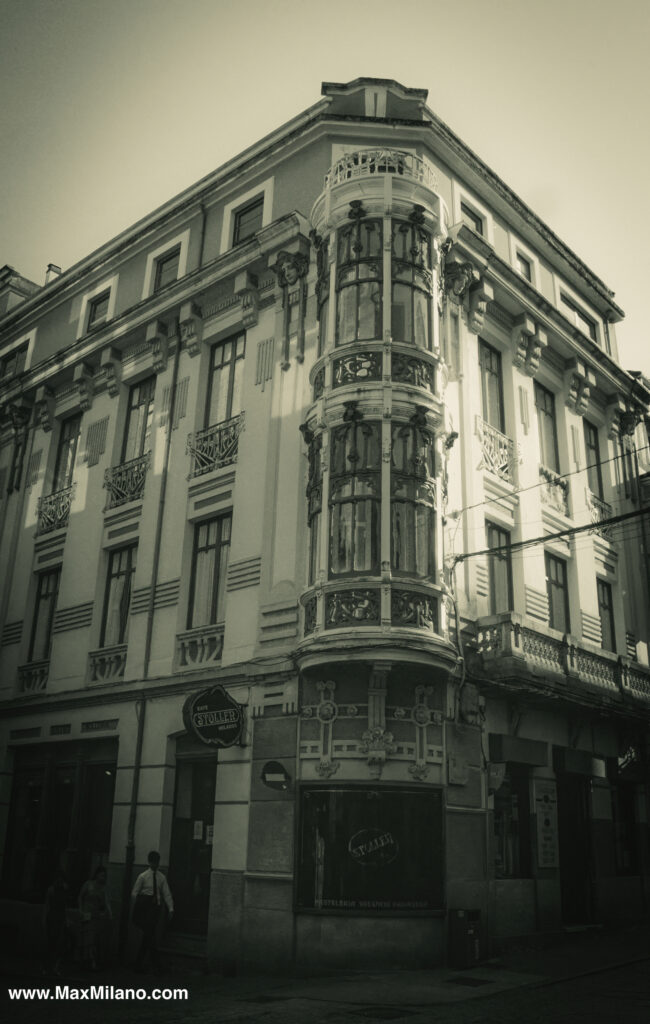
Ferrol was the birthplace of Francisco Franco and was even renamed El Ferrol del Caudillo under his rule. It was the main naval base of Spain’s Atlantic fleet until the Spanish-American War.
After that war, British engineers were invited to work at the Ferrol shipyards to build modern ships for the Spanish navy. This brought English engineers and curious travelers into the orbit of the Camino de Santiago. Later, during Franco’s rule, eager to place his hometown on the Camino map, he ordered clerics to determine the minimum distance necessary to qualify as an official pilgrim. Unsurprisingly, the verdict declared that the exact distance between Ferrol and Santiago de Compostela fulfilled the requirement. And so El Camino Inglés (the English Way) was born.
Miño
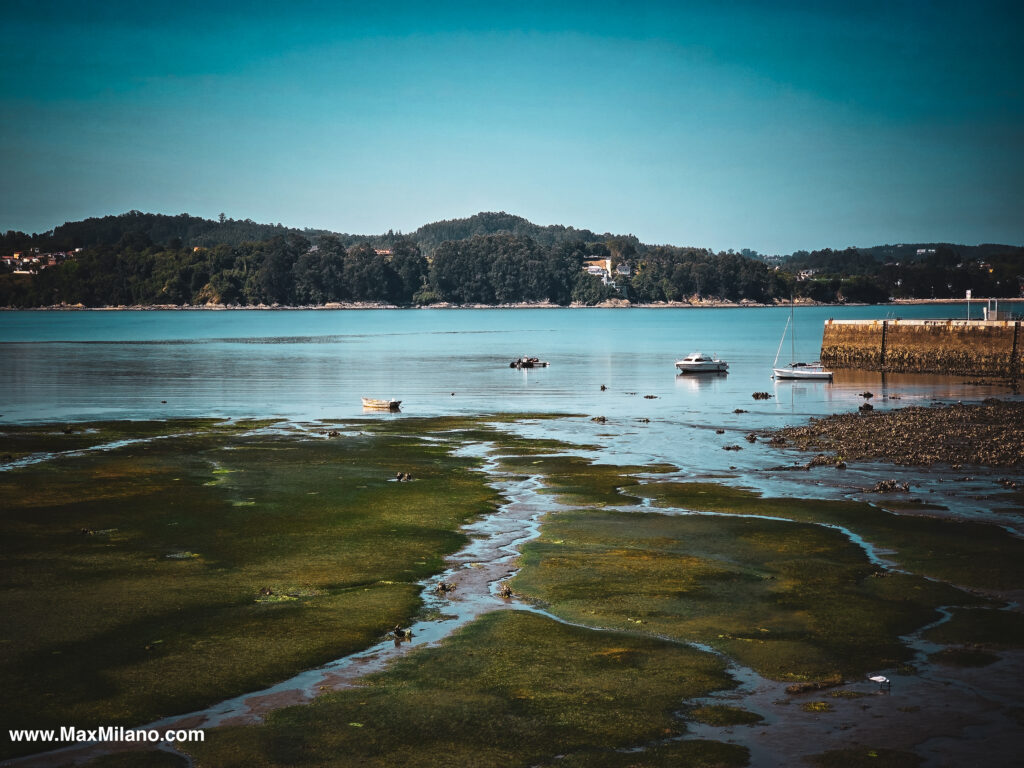
The next morning, we woke up in Miño, a dream of a town at the end of a narrow bay of emerald waters and yellow sand. Tiny, idiosyncratic, perched on a slope that spills directly onto the beach through bars and cafés full of Galician crusty old fogeys drinking their 10 a.m. beers and eating toasted bread. Some of its bars even give out free bowls of tripe soup for soakage.
We walked downhill to the beach from our hotel, a little jewel perched above the main road, its narrow terrace presided over by a landlady like one of those Victorian Signoras who hosted respectable English schoolgirls on their grand tours.
Breakfast had been plentiful and enjoyable on the terrace until the ubiquitous Galician inn’s resident Quasimodo gave us too much of an uncanny valley feeling, driving us down to the beach. Galicia seems to have a law that every charming small inn must include one slow adult milling about the lobby, possibly the product of inbreeding. They’re usually harmless, but this one worried us enough that the prospect of walking downhill to the beach, and later trudging back uphill in the heat, felt preferable to staying in the shade with him peering over our shoulders, nervously rocking.
We eventually learned he was the self-appointed patio-furniture-cushion rearranger, and our lingering over coffee had made him anxious.
He made us anxious too, especially later that night when we returned in the dark and ran into him wandering the hallway between the parking lot and the lobby. Gentle giant or potentially dangerous oddball? Hard to say. Only that every Galician inn seems to have one.
Pontedeume
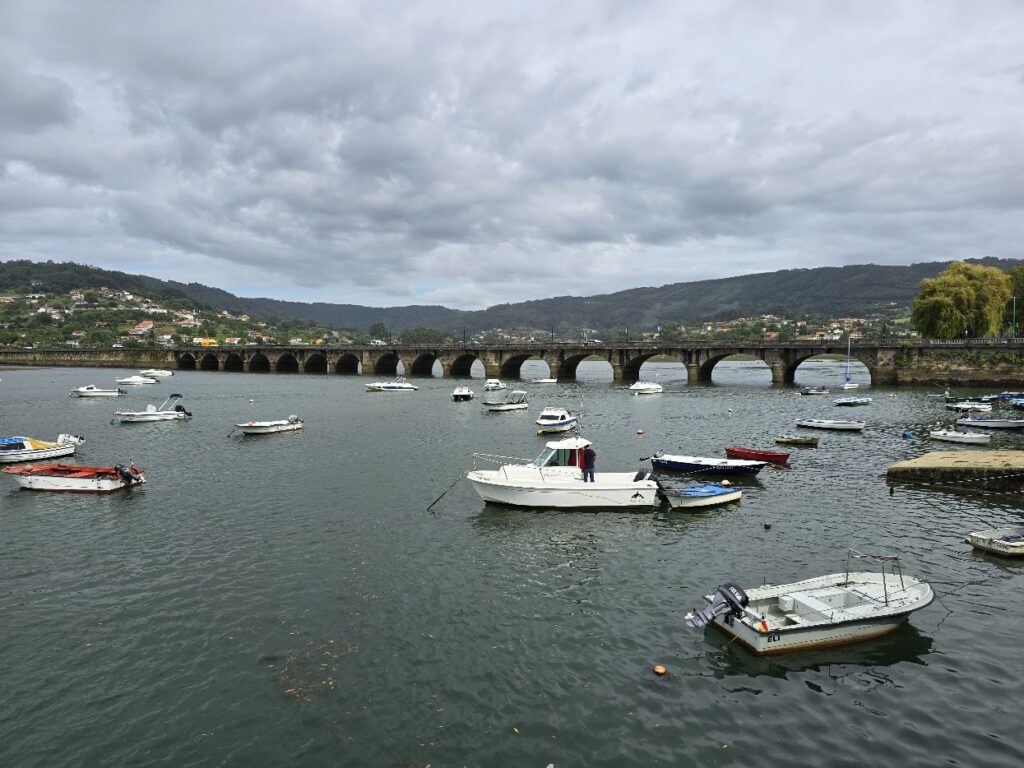
By noon, it was getting hot, so we went back to the refuge of our air-conditioned car to explore the coast. Leaving Miño was dreamlike: green hills, narrow country roads, and views of green-blue bays. After many twists and turns, we arrived in the quasi-medieval town of Pontedeume, with its picturesque marina and a bridge across a narrow channel leading to a pine park on the beach.
We parked and walked the cobblestones looking for a restaurant willing to feed us without reservations. We stumbled into a tiny café run by a young Italian boy and his mother. The menu was a small blackboard with only four types of pasta: pesto, carbonara, burro, and aglio e olio. I ordered pesto; my wife chose the carbonara. I practiced my Italian with the young waiter as he brought us a bottle of crisp white from Rías Baixas.
We watched his mother make each dish individually, preparing every sauce from scratch. She was trim, youngish, with the pale look of a Milanese single mother who had abandoned her high-powered career to move to the ends of the earth and run a two-person pasta operation.
As she fried cubed guanciale and whipped egg yolks, she told us she had been a scientist at Stanford. I didn’t dare ask why she ended up here, but she seemed content enough.
My pesto was magnificent; creamy, nutty, green, perfectly smothered in pecorino. My wife’s carbonara gleamed with crispy guanciale and whipped white sauce. Some American tourists would fault us for eating Italian food in Spain, but we live here now, so we’re allowed. Besides, none of the local octopus restaurants or the famous Galician Pulperias would seat us without a reservation.
Ares
We continued down the impossibly beautiful coast looking for shade, coffee, a beer, and a view of the ocean as the day grew hotter. The road wound between sea and mountains until we reached Ares.
Spain has festivals year-round, full of traditional costumes; Valencian Falleras, Moors and Christians (complete with blackface). But nothing prepared us for this.
As we drove into Ares, every adult male wore a crisp white guayabera and a Panama hat. Some had fat Cuban cigars tucked into their pockets or teeth. Their wives wore Afro-Cuban dresses with bright headwraps, except they were white Galician women cosplaying Havana. Spaniards are oddly comfortable with blackface; this was par for the course.
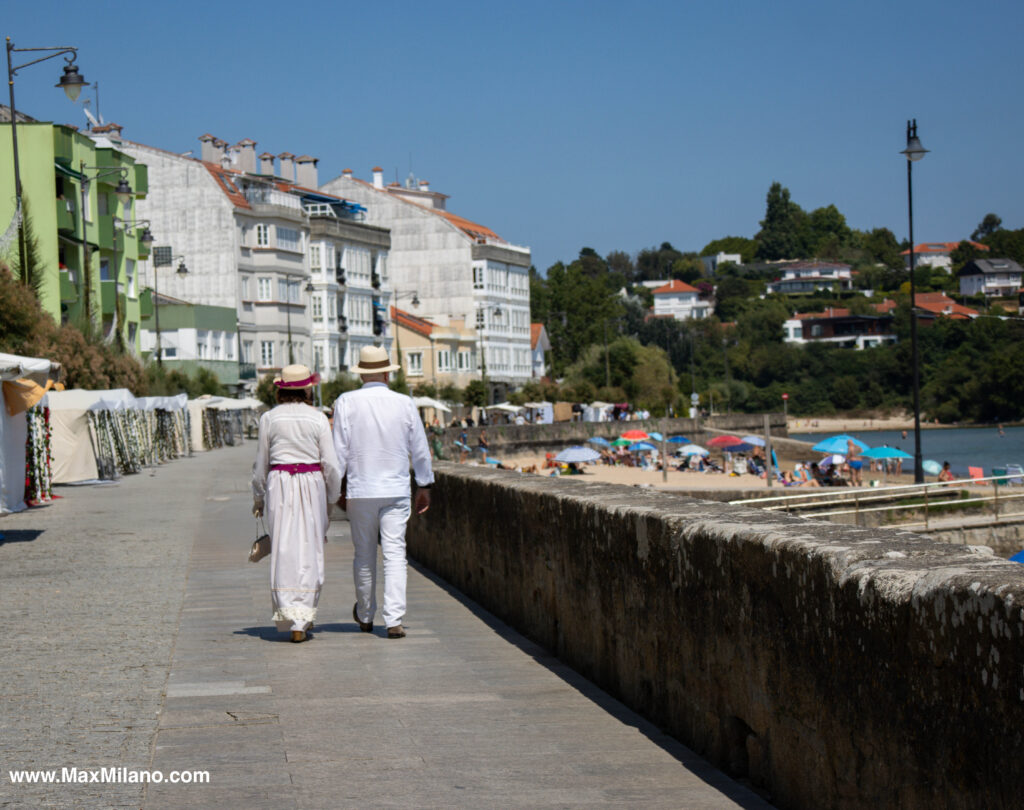
We parked and wandered the boulevard, following the hordes of colorfully dressed couples. I grew up partly in Puerto Rico, and the guayaberas reminded me of my uncles.
“This whole town is Cuban-cosplaying,” I told my wife as they streamed past.
We later learned the town dresses like this once a year to honor the thousands of locals who emigrated to Cuba and Puerto Rico in the late 1800s. Their remittances funded the town’s first school and many civic buildings.
A Coruña
We left Miño in love with it but feeling the love unrequited. The south beckoned. Portugal called. But first, a stop in Galicia’s big city: A Coruña.
A Coruña has a big mouth and lots of attitude. It swaggers like it’s writing checks it can’t cash. I’ll grant it brews the best big-brand beer in Spain, Estrella Galicia, especially the darker 1906 ales. And in August, a cold draft is a cold draft.
They eat a lot of octopus, too, and even built a giant octopus statue on a coastal hill, so we drove up to admire the view and the creature.
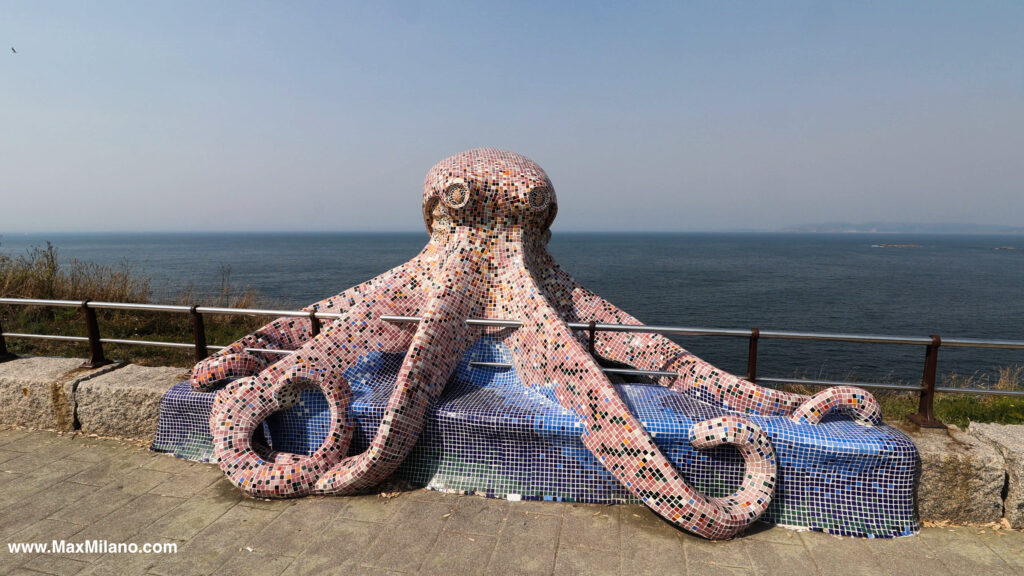
A Coruña’s harbor is stunning, with rough cliffs, giant waves crashing against dark blue water that seems intent on swallowing ships whole. No matter where we looked, waves were slamming against rocks, near or far. It is a harbor worthy of the world’s great cities.
We noticed a huge cargo ship preparing to depart. We wondered how it would navigate the violent swells beyond the harbor mouth as we stood by the giant octopus statue, cute as a Japanese anime monster, seemingly freshly crawled out of the bay to hug the road like one of those radioactive monsters that regularly emerged from Tokyo Bay in the Godzilla movies.
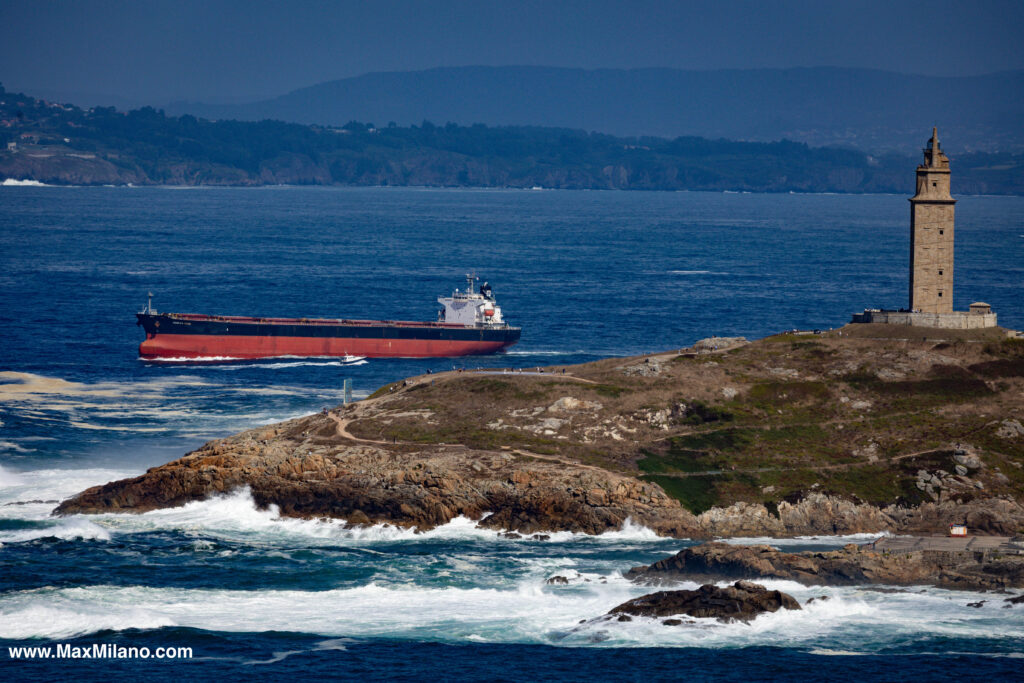
We drove up a hill to a viewpoint overlooking the entire bay, city, and open ocean and waited to watch the giant orange cargo ship depart the bay through a narrow, rock-laden passage guarded by the 2,000-year-old Roman lighthouse.
The ship gathered speed, rocking and rolling as it passed the lighthouse, then pushed into the open ocean. Soon it was just a shrinking shape sinking into the horizon.
The sun began to set behind the Roman lighthouse, bathing the waves and the mist in gold. It felt good to look west and watch the sun drop into the ocean because it felt like being in California again, only that where we stood, Romans had once kept fires burning atop their lighthouse to keep ships from smashing into the Costa da Morte, the jagged coast of death that guards northern Galicia.
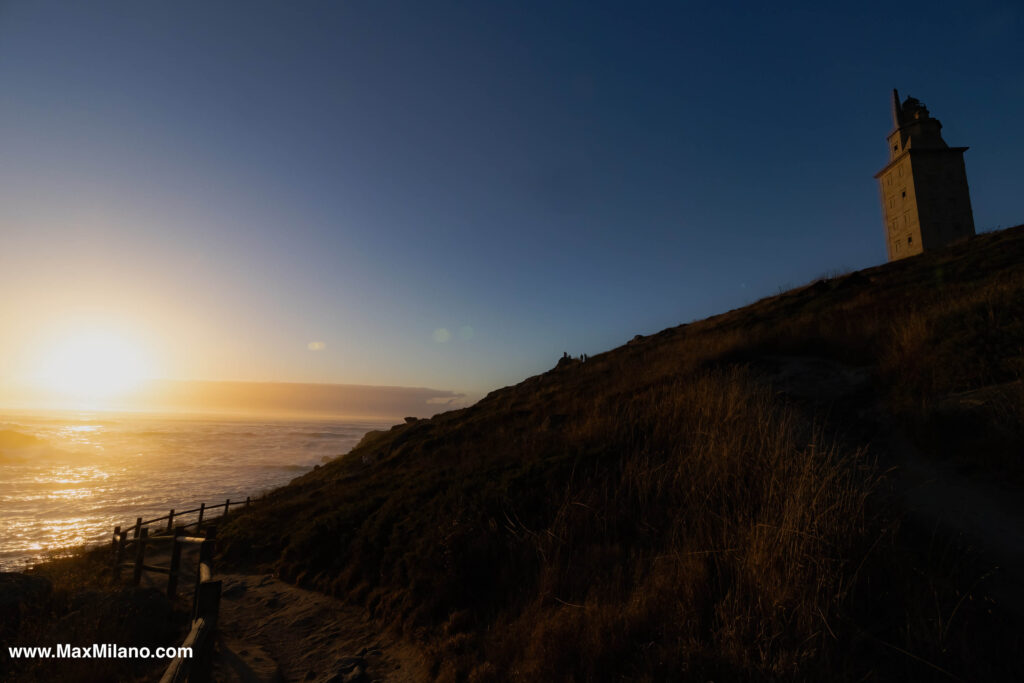
We began to feel the pull of the South more strongly. Of Portuguese sardines and Porto wine, so we left the rocky shores of A Coruña in search of the last leg of the Camino: El Camino Portugués, the Portuguese Way.
Read The Full Camino de Santiago Roadtrip Series:
El Camino de Santiago Prologue: Valencia to Cuenca
El Camino de Santiago Part 1: Cuenca to Bilbao
The Road to Santiago Part 2: La Rioja to Bayonne
The Road to Santiago Part 3: Cantabria to Galicia
The Road to Santiago Part 4: Galicia & The End of El Camino
Looking for tips on driving, food, and where to stay? Check out the Practical Information section in Part 4 of this series.
Max Milano is a travel writer and photographer based in Los Angeles, California, and Valencia, Spain. His latest photography book, Mexico City Noir, Life Under The Volcanoes, is Available on Amazon. His photographs are available at MaxMilanoPix.
Practical Information
Planning a road trip in Spain? Here are some practical tips to make your Camino (or any Iberian road trip) smoother, cheaper, and more enjoyable.
Transportation
- Car rentals: AutoEurope consistently offers some of the best rates in Europe. Always spring for the zero-deductible insurance option. Spanish roads are full of narrow medieval streets and hidden stone curbs.
- Last-minute rentals: Expedia often has good deals if you suddenly decide to extend your trip.
- Long-term rentals: For trips of a month or more, try OKMobility. Be aware that they may sometimes request an International Driver’s Permit (IDP). You can easily get an International Driver’s Permit (IDP) at your local AAA office before leaving the U.S.
- Navigation: Google Maps works well in cities, but in rural areas like Galicia or Castilla, it can become confused by old farm roads. Download offline maps before you go.
Accommodation
- We skip Airbnb for many reasons. On our latest El Camino road trip, we used Google Maps to find hotels along our route and called them directly the day before or even the same day. Google usually links to the hotel’s website or booking page.
- Pro tip: Always compare the hotel’s direct price with that of Expedia or Booking.com. Sometimes the hotel offers a cheaper “direct booking” discount; other times, the platforms offer a better deal. Check both.
- Camino towns: Outside of big cities, expect simple pensiones or pilgrim hostels. They’re basic, but cheap and full of character.
Food
- Spain runs on strict meal times. Lunch (the big meal) is from about 1:30 to 3:30 PM. Dinner rarely starts before 8:30 PM.
- In small towns, arriving outside these hours often means no food until kitchens reopen. Always carry snacks or a picnic lunch.
- Supermarkets to the rescue: Carrefour, Mercadona, and Gadis offer excellent ready-made takeout options, including tortilla española, fresh bread, local cheeses, and wine that costs less than bottled water.
Money
- Spain is card-friendly, but some tiny bars and gas stations still prefer cash. Keep some cash handy.
- ATMs: Avoid Euronet; they charge insane fees. Stick with ATMs attached to reputable banks, such as Santander, BBVA, or Caixa.
Other Essentials
Packing: A light rain jacket is essential in Galicia, even in summer. Comfortable walking shoes are non-negotiable.
Gas stations: Many are self-service with payment machines. Use Carrefour gas stations to earn points; it will help cover the cost of many of your snacks during a long road trip.
Language: In big cities, you’ll find English speakers. In rural Galicia or Castilla, don’t count on it. A few phrases in Spanish (or Galician!) go a long way.
Heads up: Some (not all) of the links above are affiliate links. That means if you book a car, hotel, or tour through them, I may earn a small commission. It helps keep the road trip going and the stories free for you.
Hermosas fotos