
By Max Milano
The Spanish bureaucrat behind the glass slides your birth certificate back across the counter.
“Necesita una traducción jurada.”
You recognize traducción. You understand that something needs to be translated. But you have no idea what jurada means, why the translation you already paid for is unacceptable, or why the clerk is now pointing toward the door.
Outside, the Spanish sun is shining. People are drinking coffee in the plaza. Somewhere nearby, a waiter is setting down a cold beer and a plate of olives. But you are standing on the sidewalk clutching a rejected birth certificate, wondering whether your residency appointment, secured after months of waiting, is about to disappear into a bureaucratic abyss.
Then your phone rings.
It is the doctor’s office about the specialist appointment you have been trying to arrange. The receptionist speaks quickly. You catch the date, or perhaps it is the time. She asks you a question. You say sí, hoping that sí is the right answer.
It isn’t.
Welcome to Spain.
Moving from the United States to Spain can feel like stepping into a better version of life: walkable cities, long lunches, excellent healthcare, sunny beaches, and wine that costs less than bottled water at an American airport.
But sooner or later, every English-speaking expat discovers that living in Spain requires more than knowing how to order a coffee.
You need to make your documents Spanish. That is not only about translating them, but also about getting them stamped and signed by an accredited translator approved by the Spanish government. Spanish bureaucrats, you will soon find out, are very fond of official-looking stamps on every document, and without this official translator stamp, your translated documents mean nothing in the eyes of the Spanish bureaucrat. And oh, yes, you sometimes need a live interpreter when something important comes up that exceeds your current level of Spanish, like a doctor’s appointment.
That is why GuiriGuru offers two types of translation support for English-speaking expats: official sworn and stamped translations of documents and practical interpreting assistance for real-life situations.
This solves two very different problems, and most people moving to Spain eventually need either one or both.
The Official Sworn Translation
Let’s begin with the paperwork, because Spanish bureaucracy will certainly make you focus on that first.
Foreign language documents do not automatically become acceptable to a Spanish government office simply because their meaning seems obvious.
A birth certificate is still a birth certificate. A marriage certificate still proves that you are married. A college diploma does not suddenly lose its degree-ness when it crosses the Atlantic.
Nevertheless, if the document is written in English and you are submitting it as part of an official Spanish procedure, you may be asked for a traducción jurada: a sworn translation into Spanish.
A sworn translation is not an ordinary translation produced by someone who happens to speak both languages. It is an official translation completed and certified by a Sworn Translator appointed by Spain’s Ministry of Foreign Affairs, European Union and Cooperation.
The translator certifies the translation’s faithfulness and accuracy using the legally required certification, signature, and identifying information. Sworn translations bearing the appropriate certification have official status and can be submitted to Spanish administrative and judicial bodies.
Depending on the procedure, American expats may need sworn translations of documents such as:
- Birth certificates
- Marriage or divorce certificates
- FBI background checks
- State criminal-record certificates
- University degrees and academic transcripts
- Medical certificates and reports
- Court judgments
- Powers of attorney
- Financial or corporate documents
- Adoption and custody documents
- Driver or employment records
The exact documents depend on what you are trying to accomplish. A Spanish visa application, residency process, university admission, professional qualification, or civil-registry procedure may each have different requirements.
And because this is Spain, the requirements can also vary depending on the government office, consulate, or person sitting behind the desk that morning.
A Translation Is Not the Same As An Apostille
This is one of the most common sources of confusion for Americans moving to Spain.
An apostille authenticates the origin of a public document for international use. A sworn translation converts that document, and usually its apostille, into an officially certified Spanish translation.
One does not necessarily replace the other.
If your procedure requires an apostilled document, getting it translated does not eliminate the apostille requirement. Likewise, obtaining an apostille does not translate the document into Spanish.
The order matters too. When an apostille is required, you will normally need to obtain it before the sworn translation so the apostille can be included in the translated document.
Before ordering anything, confirm the requirements for your specific visa, residency application, or administrative procedure. GuiriGuru can help you determine which translation service you need, but the authority handling your case has the final say on which documents it will accept.
Why Deadlines Matter More Than You Think
A missed translation deadline is not merely inconvenient.
Visa and residency appointments can take weeks or months to obtain. You may also be working within the validity period of a criminal-record certificate, medical certificate, or other time-sensitive document.
If your appointment is on Tuesday, a perfect translation delivered on Wednesday is not perfect. It is late.
That can mean rescheduling an appointment, ordering updated documents from the United States, paying for another apostille, or delaying your move altogether.
At GuiriGuru, we work with experienced, Ministry-appointed Sworn Translators who understand that accuracy and timing are equally important. You receive clear instructions, realistic delivery expectations, and a professionally completed official translation suitable for the procedure for which it was ordered.
Depending on where you are submitting your documents, your sworn translation can be delivered in one of two official formats.
A digitally signed sworn translation is issued as an electronic document, usually a PDF. It contains a qualified electronic signature that verifies the translator’s identity and protects the document against undetected changes. This is an original electronic translation, not simply a scanned image of a handwritten signature or physical stamp. It is particularly useful when submitting documents through an online government portal or sending them electronically to a lawyer, consulate, or immigration office.
A traditional sworn translation is issued on paper and bears the translator’s handwritten signature and physical official seal. This format may be preferable when an authority asks for an original paper translation or when documents will be presented in person.
Both formats are legally recognized in Spain. However, the receiving consulate, notary, or government office may specify which format it accepts. GuiriGuru can help confirm the requirements before your translation is prepared, so you receive the correct version the first time.
The important thing is not merely converting English words into Spanish. It is producing the right translation in the right format by an appropriately appointed professional and, more importantly, having it ready when you need it.
The Official Interpreter Who Signs The Deed With You
The keys to your new home in Spain are almost within reach.
You are sitting beneath the fluorescent lights of a Spanish notary’s office, surrounded by the seller, an estate agent, a lawyer, and several people shuffling documents with the grave expressions of diplomats negotiating a peace treaty.
A thick property deed lies on the table.
The notary begins reading it aloud, in rapid, formal Spanish.
You understand comprador. You recognize your name and the price of the property. Everything else becomes a stream of legal clauses, tax references, and words that you have never heard during a conversation at your local café.
You look at your bilingual spouse and whisper, “Can’t you just translate it for me?” The answer is no.
Buying Property In Spain Is Not An Everyday Conversation: You Need An Official Translator
For a medical appointment, telephone call, or meeting with a service provider, an ordinary bilingual person can usually help you communicate. Signing a property deed before a Spanish notary is different.
The notary must be satisfied that every person signing the deed understands what they are agreeing to. This matters because you are not merely collecting the keys. You may be accepting debts, taxes, community charges, property boundaries, contractual obligations and mortgage conditions with serious financial consequences.
Article 150 of Spain’s Notarial Regulations sets out two possible solutions when a foreign buyer does not understand Spanish.
If the notary speaks the buyer’s language, the notary can translate the contents of the deed verbally and formally record that the buyer’s wishes are accurately reflected in the document.
If the buyer does not understand Spanish and the notary does not speak the buyer’s language, the regulations require an official interpreter to assist with the signing. That interpreter provides the necessary oral or written translations and accepts responsibility in the deed for their accuracy.
In other words, bringing along a friend who spent a semester in Barcelona, or a real estate agent who insists that her English is “basically perfect”, may not be enough.
Why Your Spouse Will Not Be Accepted
Your spouse may speak excellent Spanish. Nevertheless, the notary may refuse to let them act as your formal interpreter if they have a personal or financial interest in the transaction.
Perhaps the property will become the marital home. Maybe your spouse is also named in the deed, is contributing to the purchase price, or could acquire rights or obligations connected with the property. In those circumstances, they are not an independent third party.
That does not mean every spouse is automatically prohibited from translating in every notary’s office. In practice, the notary controls the signing and decides whether the proposed interpreter is sufficiently competent and independent for that particular transaction.
But this is not something to discover after everyone has assembled to sign.
The safest approach is to use an independent professional accepted by the notary and confirm the requirement well before the appointment.
Does The Interpreter Need To Be A Lawyer?
No. A lawyer is not automatically qualified to act as an official interpreter simply because they understand Spanish law or speak English.
A lawyer might be accepted if the notary approves the arrangement. They could also act as the official interpreter if they hold the appropriate interpreting qualification separately. But being admitted to the bar does not, by itself, make someone an intérprete jurado.
A lawyer explains the legal effect of the transaction and protects your interests. An interpreter ensures that the spoken communication is conveyed accurately between languages. One person may possess both qualifications, but they are distinct professional roles.
Translator Or Interpreter? The Difference Matters
Spain’s Ministry of Foreign Affairs distinguishes among three related professional titles:
- A Traductor Jurado is authorized to produce official written translations.
- An Intérprete Jurado is authorized to provide official oral interpretation.
- A Traductor-Intérprete Jurado is authorized to perform both services.
The Ministry maintains an official directory that identifies which form of authorization each professional holds.
This distinction is important. Someone qualified to stamp and certify the written translation of your birth certificate is not necessarily authorized to interpret the spoken proceedings at a property signing.
The Interpreter Becomes Part Of The Official Act
An official interpreter does not merely sit quietly beside you and whisper a summary whenever the notary pauses.
The interpreter is formally identified in the deed, participates in the signing, and declares responsibility for the accuracy of the interpretation. The deed records the involvement of interpreters, witnesses, or other professionals participating in the act.
That is why the notary needs to approve the arrangement in advance. The interpreter is helping the notary establish that you understood the deed and freely consented to its terms.
A Real Person To Help You Communicate In Everyday Situations In Spain
Official documents are only half the story.
Your birth certificate may need a Sworn Translator, but the receptionist at the health center does not need a stamped document. She needs to know why you are calling.
That is where GuiriGuru’s practical translation and interpreting support comes in.
This service is for the everyday moments when automated translation is not enough and struggling through the conversation yourself could lead to an expensive, embarrassing, or potentially serious misunderstanding.

We can help you communicate:
- In person at a doctor’s appointment
- Over the phone with a clinic or hospital
- With a landlord, property manager or utility company
- At a bank, insurance office or local business
- During an appointment with a service provider
- When arranging repairs for your home or car
- With a homeowners’ association
- When resolving billing, scheduling or administrative problems
- During other important conversations where clear Spanish matters
Sometimes you need someone to attend an appointment with you. Sometimes you need a translator to join a phone call. And sometimes you simply need us to call a Spanish-speaking organization, explain the situation, and help you get a clear answer.
This is not the kind of interpreting used in a courtroom or in other proceedings that specifically require a Sworn Interpreter. It is practical, human language support for navigating daily life in Spain.
Why Google Translate Cannot Always Save You
Translation apps are wonderful when you want to ask whether the restaurant serves gluten-free bread.
They become less wonderful when a doctor is discussing medication, a landlord is explaining a contract dispute, or an insurance company is asking a question that could affect your coverage.
Language is not just vocabulary. It is context, tone, local usage, and knowing when ahora means now, in a little while, or at some mysteriously undefined point later today.
Automated tools can also produce sentences that are technically understandable but socially awkward. They cannot always recognize when someone has misunderstood your question. They do not know which detail matters most, when to ask for clarification, or how to politely push back when you are being passed from one department to another.
A human translator can listen to both sides, identify the misunderstanding, and keep the conversation moving.
That is often the difference between receiving information and actually solving the problem.
Translation Help From People Who Have Made The Move
GuiriGuru was created by a pair of expats who moved from California to Spain and learned to navigate the system the same way most foreigners do: one government office, misunderstood telephone call, and mysterious form at a time (and that even when one of them was 100% fluent in Spanish!).
We know how vulnerable it can feel to handle an important appointment in your second language. Even people who speak conversational Spanish can struggle when the subject suddenly shifts to medical terminology, administrative procedures, insurance conditions, or legal language.
We also know that asking for help should not make you feel helpless.
Our goal is to give you enough support to understand what is happening, make informed decisions, and move forward confidently. We explain things in clear English, help you prepare for the conversation, and make sure your questions do not disappear in translation.
Whether you need a single sworn document translated officially, or someone beside you during a difficult appointment, GuiriGuru gives you access to the right kind of translation help for the situation.
Meet Vanessa: GuiriGuru’s Official Spanish Sworn Translator
Vanessa Hernández Peral has been a Sworn Translator of English, appointed by Spain’s Ministry of Foreign Affairs and Cooperation, since 1999.
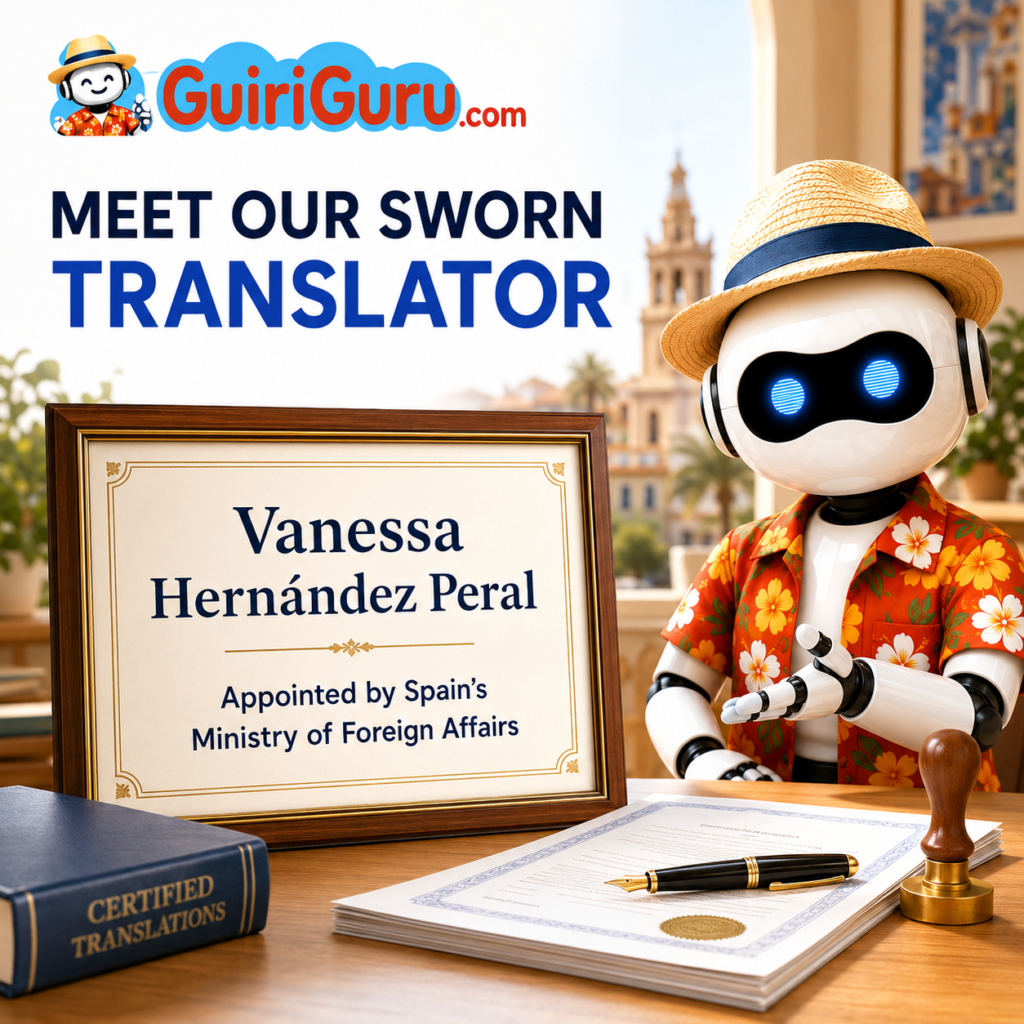
During her 27 years of professional experience, Vanessa has worked with clients from around the world. Her work extends far beyond written documents. She has also provided oral interpreting services at notary offices, police stations, real estate agencies, courts, law firms, homeowners’ associations, hospitals and health centers.
For Vanessa, two qualities define an excellent Sworn Translator: precision and reliability.
A sworn translation must faithfully and completely reproduce the original document. But it must also be delivered within the agreed deadline. This becomes especially important when someone has waited months for a Spanish visa appointment and cannot afford to lose it due to an incomplete translation.
Vanessa’s work has helped many English-speaking expats obtain residency and begin new lives in Spain. She sees every file not simply as another document, but as part of someone’s plan: a visa, a home, a family reunion or a new beginning.
Making that process simpler, faster, and less intimidating is central to the way she works.
Which Translation Service Do You Need?
The simplest way to decide is to ask what the translation needs to accomplish.
If you are submitting an English-language document to a Spanish government agency, court, consulate, university, notary, or another official institution, you may need a sworn translation.
If you need help understanding or speaking during an appointment, phone call, or everyday interaction, you probably need practical interpreting support.
In some situations, you may need both.
For example, you might need a sworn translation of an American medical report, followed by an in-person interpreter to help you discuss it with a Spanish-speaking specialist. You may need your marriage certificate officially translated for a residency application, followed by help calling the town hall to check the status of your file.
You do not have to work out the distinction alone. Send us the document or describe the situation, and we will help identify the appropriate service.
Don’t Let Language Put Your Move On Hold
Moving to Spain should be about building a new life, not spending your days wondering what someone at the town hall just said to you.
GuiriGuru can help with both sides of the language barrier: official sworn translations for the documents that make your move possible and personal interpreting support for the conversations that make life here work.
Tell us what you need translated, when you need it, and where it will be submitted. If you need help with an appointment or telephone call, explain the situation and let us know whether you require in-person or remote assistance.
We will help you choose the right service, understand the process, and take the next step without getting lost in translation.
Need A Sworn Translation Or Personal Interpreting Assistance In Spain?
Contact GuiriGuru Translation Services and let us help you navigate Spain in clear English, and accurate Spanish.