
By Max Milano (Travel Writer and Photographer)
I consider myself something of an old hand when it comes to total solar eclipses. The upcoming total eclipse in Spain will be my third.
That is nothing to boast about, since solar eclipses are not especially rare on a planetary scale. Somewhere on Earth, between two and five solar eclipses occur every year, although many are only partial. A total solar eclipse happens somewhere on our planet roughly every 18 months. The trick is having one pass through your particular neck of the woods. At any single location, the average wait between total solar eclipses is measured in centuries.
Occasionally, however, a region gets extraordinarily lucky. Chile experienced two total eclipses in quick succession, on July 2, 2019, and December 14, 2020. The continental United States received its own remarkable pair on August 21, 2017, and April 8, 2024. The 2017 eclipse was the one that turned me into an eclipse chaser. The next total eclipse to touch the contiguous United States will arrive on August 23, 2044, followed by a much larger coast-to-coast eclipse on August 12, 2045. Spain is the lucky one now, with the upcoming August 12, 2026 total eclipse and another one on August 2, 2027.
I have seen plenty of partial solar eclipses and even a few lunar eclipses. As impressive as those can be, they do not hold a candle to totality.
Standing inside the path of totality is an entirely different experience. As the Moon gradually bites into the Sun, the light begins to change. Shadows grow sharper and stranger. The temperature drops. Animals alter their behaviors: birds may begin to roost, nocturnal creatures emerge and insects start their evening chorus at the wrong time of day.
As an unnatural dusk creeps across the land, something primal awakens in the brain, a mixture of wonder, excitement and the irrational fear that the Sun may never return.
The geometry behind it is almost as extraordinary as the experience. The Sun is about 400 times wider than the Moon but also approximately 400 times farther away, so the two appear nearly the same size in our sky. Other moons elsewhere in the Solar System can produce eclipses, but the close apparent match between our Sun and Moon gives Earth’s total eclipses their particularly dramatic appearance. It allows the Moon to cover the brilliant solar surface while exposing the Sun’s faint outer atmosphere, the corona.
It is another fascinating feature of life on this third rock from the Sun, the only world currently known to support carbon-based life.
The Moment of Totality
Watching the Moon slowly nibble away at the Sun is spectacular, but something mystical happens when totality finally arrives.
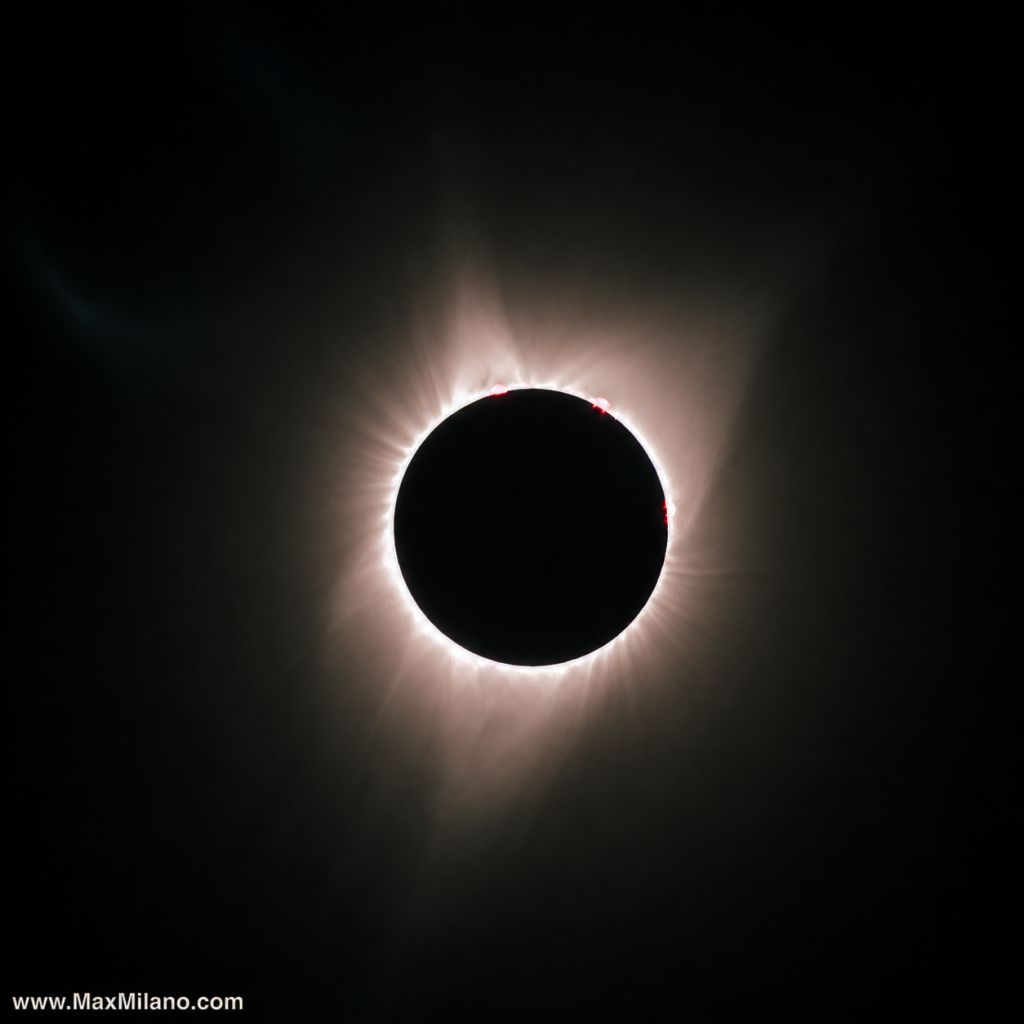
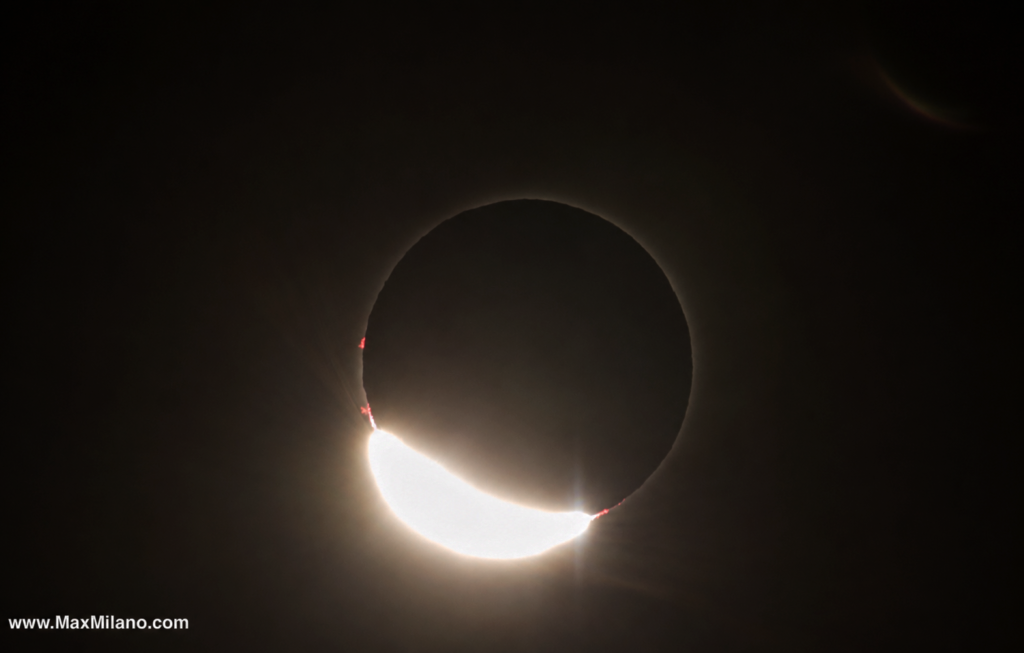
The last brilliant point of sunlight disappears, producing the famous diamond-ring effect. Day suddenly becomes night. A 360-degree twilight surrounds the horizon while the sky overhead turns dark enough for planets and bright stars to emerge.
Then the corona appears.
It can look like glowing white or silver fire radiating from the black disc of the Moon, a black hole or portal suspended in the sky. Red or orange solar prominences may also become visible around the edge, giving the whole spectacle the appearance of some vast celestial Eye of Sauron.
No photograph can truly capture it. A camera flattens the contrast and scale; your eyes and brain experience the entire sky transforming around you.
There is a famous story about Christopher Columbus exploiting the terror inspired by an eclipse. Stranded in Jamaica in 1504, Columbus used astronomical tables to predict that the Moon would turn dark and red. He then manipulated the Indigenous Jamaicans by claiming that his god was angry with them. When the lunar eclipse began, they reportedly begged him to restore the Moon.
Even as a scientifically literate person living in the 21st century, you may feel some distant echo of that ancient fear when you witness totality for the first time. You know perfectly well that the Sun will return, but some deeper part of your brain is not entirely convinced.
My First Total Eclipse: Oregon, 2017
My first total eclipse was in 2017. We drove north from San Francisco into Oregon’s Willamette Valley, where towns and college communities were buzzing with excitement and free eclipse glasses were being distributed.
At the moment of totality, someone played Pink Floyd’s “Set the Controls for the Heart of the Sun.”
As the corona appeared, daylight vanished, and twilight wrapped itself around the entire horizon. That was it. I was hooked. I had become an eclipse chaser.
My next eclipse required considerably more effort than a drive to Oregon. We flew approximately 14 hours from Los Angeles to Santiago, Chile, and then drove north towards La Serena and the edge of the Atacama Desert, five hours north of Santiago airport.
The landscape around La Serena is barren, red and otherworldly. The snow-covered peaks of the Andes dominate the horizon to the east, while the Pacific Ocean stretches away to the west. Chile is such a narrow country that you can see the Andes from the beach.
We visited a small Indigenous coastal community and took a boat towards islands populated by Humboldt penguins. Dolphins breached ahead of us as if guiding the way, and whales spouted nearby. I photographed the penguins hopping across the rocks like tiny waiters dressed in dinner jackets.
The night before the eclipse, the town was awash with gringos. Everyone was anxious about choosing the right viewing location because coastal fog was in the forecast.
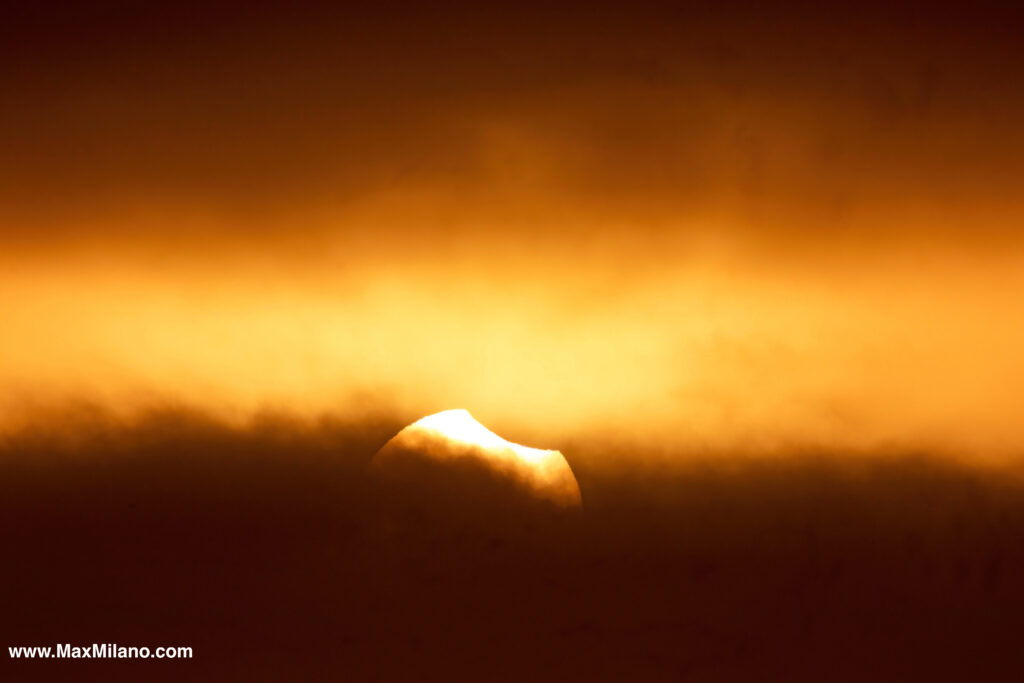
Coming from the San Francisco Bay Area, fog did not frighten me. I knew that if it were thin enough, the sunlight would penetrate it and make the changing light even more spectacular.
On eclipse day, we drove into the desert. After spotting guanacos and a desert fox, we joined a small group of Chileans and Americans who had set up camp beside the road. There was almost nothing around us, only rock, sand, the distant Pacific to the west and the mighty Andes to the east.
As the shadows lengthened, desert foxes emerged and nocturnal birds appeared to awaken in confusion. Then totality arrived, and the corona became the brightest and most beautiful thing above the desert.
The fog eventually rolled in, washing the final stages of the spectacle in veils of orange light.
We missed Chile’s next total eclipse, on December 14, 2020, because of the pandemic and its travel restrictions. We are not going to miss this one.
The 2026 Total Solar Eclipse in Spain
As August 12, 2026 approaches, I can feel the excitement building, particularly among Americans traveling to Spain for the eclipse.
However, anyone planning to watch it from Spain needs to understand what makes this eclipse both special and difficult.
The path of totality will cross Spain from west to east, beginning in northern Galicia and continuing through Asturias and Cantabria, parts of Castilla y León, the Basque Country, La Rioja, Aragón, parts of Castilla-La Mancha, the northern Valencian Community, parts of Catalonia and the Balearic Islands.
The band does not cover each of these regions in full. A city or beach can be geographically close to the path and still experience only a partial eclipse. Every proposed location must therefore be checked individually.
Among the provincial capitals officially confirmed to be inside the path are A Coruña, Oviedo, Santander, León, Palencia, Burgos, Bilbao, Vitoria-Gasteiz, Logroño, Soria, Zaragoza, Teruel, Castellón, València, Tarragona, Lleida and Palma.
The maximum phase will occur at approximately 8:28 p.m. in A Coruña, 8:29 p.m. in and around Burgos, and 8:32 p.m. in Palma, although the precise time depends on your exact location.
The critical factor is the Sun’s elevation.
According to Spain’s Instituto Geográfico Nacional, the Sun will be approximately 12 degrees above the horizon in A Coruña and about eight degrees high in Burgos. By the time the eclipse reaches Palma, it will be only about two degrees above the horizon.
That means you cannot simply choose a city inside the path of totality and assume you will see the eclipse. A building, hill, mountain ridge or line of trees in the wrong direction could completely block it.
The Valencia Problem
València lies within the path of totality, but it is one of the more challenging places from which to observe this eclipse.
The Valencian coast faces primarily east, making it wonderful for sunrises but generally poor for sunsets. The word Levante itself evokes the rising Sun. During the eclipse, however, the Sun will be setting towards the west-northwest, over land rather than over the Mediterranean.
Mountainous terrain rises inland from the Valencian coast. Add apartment blocks, trees and other urban obstructions, and a location that appears suitable on a conventional eclipse map may provide no view of the eclipsed Sun at all.
If you choose València, select your exact viewing position extremely carefully. A rooftop, elevated west-facing terrace, open agricultural area or location with a long, unobstructed west-northwestern sightline may work. Simply standing on an east-facing beach and looking out to sea will not.
A useful free tool is Eclipse in My City. Enter the address or proposed viewing location and it will display a Google Street View simulation showing where the Sun should appear during the eclipse. Use it to identify buildings and trees that could block your view.
Spain’s official IGN Eclipse Viewer can then help confirm the eclipse timing, Sun elevation, totality status and natural terrain at your selected location.
Use both tools. The street-level simulator helps reveal buildings and trees, while the official IGN viewer confirms whether the exact point is genuinely inside the path of totality.
A Photographer’s Dream
The low elevation creates serious logistical problems, but it also gives photographers an unusual creative opportunity.
During many total eclipses, the Sun is so high that photographs show little more than the eclipsed Sun against a dark sky. But on August 12, 2026, it may be possible to include mountains, buildings, monuments, trees, boats or the ocean in the same frame.
A west-facing Atlantic beach inside northern Galicia’s totality band, with a dramatic foreground and an unobstructed horizon, is therefore high on my list.
The distinction matters. A Coruña and Ferrol will experience totality, but Fisterra, despite its famously western position and excellent ocean horizon, is outside the path and will experience only a partial eclipse. Choosing a photogenic western beach is not enough; the exact location must also lie comfortably inside the totality band.
Northern Galicia’s principal disadvantage is Atlantic cloud and fog. The Sun will be higher there than in València or the Balearic Islands, but the statistical probability of clear skies is lower than across much of inland Spain.
That is the central gamble of this eclipse: western Spain offers a higher Sun, while the drier eastern and interior locations may offer better odds of clear weather but a much lower Sun.
Do not rely on a long-range forecast published weeks in advance. Spain’s official eclipse guidance recommends checking AEMET during the final days before the event. Keep several backup locations inside the path of totality and be prepared to move if the forecast changes.
Top Places to See the 2026 Total Eclipse in Spain
There is no single “best” location. The correct choice depends on the balance between four factors: cloud probability, Sun elevation, totality duration and the openness of the west-northwestern horizon.
Every location recommended below has been selected because it lies inside the path of totality. However, totality status alone does not guarantee that the Sun will be visible from a particular street, beach, terrace or field.
1. Castilla y León: León, Palencia, Burgos and Soria
For many eclipse chasers, the confirmed totality locations in Castilla y León offer the best overall compromise.
The region has large areas of open terrain, a relatively dry August climate and a Sun that will remain higher than it will along Spain’s of Mediterranean coast. Burgos will experience approximately 104 seconds of totality with the Sun around eight degrees above the horizon. León, Palencia and Soria are also safely within the path and should offer good totality durations.
The ideal site is not necessarily inside one of these cities. Urban buildings can still obstruct a low Sun. Look instead for open farmland, a plateau, a broad west-facing valley or an accessible viewpoint outside town, but verify that the exact rural location remains inside the totality band.
Avoid positioning yourself immediately east of a mountain ridge. A site may appear high and open while still having a raised western horizon. Check the terrain digitally and visit the site beforehand if possible.
Castilla y León is probably the safest all-round recommendation for people who prioritize seeing totality over obtaining an ocean photograph.
2. Northern Galicia: A Coruña, Ferrol and Verified Coastal Locations
Northern Galicia offers the highest Sun elevation available in mainland Spain during totality. In A Coruña, maximum eclipse will occur at approximately 8:28 p.m., with about 76 seconds of totality and the Sun roughly 12 degrees above the horizon.
Ferrol is also inside the path and should experience approximately 89 seconds of totality, with the Sun at a similar elevation.
Twelve degrees is still low, but it is considerably more forgiving than the two-to-four-degree elevation expected farther east. It also creates superb photographic opportunities involving the Atlantic, cliffs, lighthouses or coastal landscapes.
A Coruña’s Tower of Hercules area could offer dramatic views, although crowd control and coastal access may become major issues. Verified west-facing coastal locations around Ferrol may provide alternatives.
Do not assume that every west-facing beach in Galicia lies inside the path. Fisterra is outside totality, and many locations in southern or southwestern Galicia will see only a partial eclipse. Check the exact beach, headland or viewpoint with the official IGN viewer before booking accommodation.
The obvious danger is weather. Galicia and the Cantabrian coast generally have higher probabilities of cloud than inland Spain. Do not assume that August guarantees a clear evening. Have one or more inland backup sites inside the totality band and be prepared to move if Atlantic cloud threatens the coast.
3. The Burgos-Soria Interior
The broader totality zone around Burgos and Soria deserves special attention. It combines comparatively favorable summer weather, long totality and open landscapes.
Soria city and the province are particularly well positioned within the band. The elevated plateau provides expansive views, while its relatively dry climate may offer better odds than the Atlantic and Cantabrian coasts.
This is excellent eclipse country for viewers who can drive and are willing to avoid the most heavily advertised locations. Local ridges, forests and rolling terrain still matter, however. A rural site inside a province experiencing totality can still have a completely obstructed western horizon.
Choose a location with road access, legal parking and more than one escape route. A remote viewpoint served by a single narrow road could become a trap when thousands of visitors try to leave simultaneously.
Do not sacrifice totality merely to gain a slightly clearer forecast. Confirm that your selected point lies comfortably inside the band, not directly beside its northern or southern edge.
4. Aragón: Zaragoza and Calatayud
Zaragoza and Calatayud are both inside the path of totality.
Zaragoza should receive approximately 84 seconds of totality, while Calatayud should receive around 101 seconds. Aragón may also offer some of the better climatological odds inside the path. The Ebro Valley is relatively dry, and its open landscapes can provide long sightlines.
Zaragoza is easily accessible and will attract large numbers of visitors. However, the Sun will be lower there than in Galicia or much of Castilla y León, so a completely open west-northwestern horizon is essential. It may be better to scout a verified rural location outside the city rather than rely on an urban park.
Calatayud is attractive because of its longer totality, but the surrounding hills make exact positioning critical. A small ridge that would be irrelevant during a midday eclipse could hide the entire total phase at sunset.
The IGN viewer and the Eclipse in My City simulator should be used together: one confirms totality and checks natural terrain, while the other helps identify buildings and trees.
Huesca is very close to the edge of the path and should not be treated as a dependable totality destination without checking the exact observation point. If totality is the goal, choose a location comfortably inside the band rather than one sitting on its boundary.
5. Oviedo, Santander and Bilbao
Oviedo, Santander and Bilbao are all confirmed totality locations. They offer a reasonably high Sun, beautiful landscapes and the possibility of framing the eclipse above mountains, cities or the Atlantic coast.
Asturias is especially attractive because some locations near the central line should experience among the longest periods of totality available in Spain,close to one minute and 50 seconds.
The trade-off is cloud. Official Spanish climatological guidance indicates that the Cantabrian coast has historically experienced clear or mostly clear conditions only around 30-50% of the time during the relevant August period.
Mountainous terrain also creates localized cloud and obstructed horizons. Bilbao may lie inside the path, but its surrounding hills make the precise viewing position especially important. A dramatic mountain viewpoint may be visually perfect but meteorologically risky, while a city street may have no useful western sightline at all.
These northern locations are best for flexible travelers who can monitor conditions and relocate inland while remaining inside the totality band.
6. València and Castellón: Mediterranean Totality with a Difficult Horizon
València and Castellón are inside the path of totality. Alicante is not.
València offers convenient transport, extensive accommodation and generally favorable summer weather. The problem is not whether the city lies inside the path, it does. The problem is whether you can physically see the Sun.
The Sun will be extremely low over the west-northwestern landward horizon. Mountains, buildings and trees could block totality from many locations, including apparently open beaches.
The best options are likely to be west-facing rooftops, open agricultural land, elevated sites with a verified sightline or other locations where the Sun remains visible at around 8:30 p.m. Any site outside the city must be checked individually because travelling too far south could take you outside the totality band.
Castellón and locations farther north may also offer totality, but the same low-Sun problem applies. The terrain rises inland, so a clear western horizon cannot be assumed.
Do not generalize this recommendation to the entire Mediterranean coast. Alicante lies outside the path of totality. Barcelona city is also outside, although Tarragona and Lleida are inside it.
Scout your location at the same time of day in the days immediately before the eclipse. The Sun’s position will be close enough to reveal obvious obstructions.
7. Tarragona and Lleida
Tarragona and Lleida are both inside the path of totality, while Barcelona city is outside it.
These areas may benefit from relatively favorable August weather, but the Sun will be very low. Tarragona’s coastal position can be misleading because much of its coastline faces east or southeast, while the eclipsed Sun will be towards the west-northwest.
Lleida’s inland setting may provide better access to open agricultural landscapes, but hills, trees and distant terrain still need to be checked.
As elsewhere in eastern Spain, the central challenge is not simply reaching the totality band. It is finding a verified point inside the band with an exceptionally clear west-northwestern horizon.
8. Palma and Mallorca
Palma and much of Mallorca lie inside the path of totality, but the island represents the ultimate high-risk, high-reward option.
Around Palma, maximum eclipse will occur at approximately 8:32 p.m., with the Sun only about two degrees above the horizon. That is astonishingly low. A distant hill, tree line, boat, cloud bank or slight haze could erase the view.
A genuinely west-facing coastline with an open sea horizon offers the best chance. Even then, totality will occur just before sunset, and atmospheric extinction may dim or distort the Sun.
The western side of Mallorca is also mountainous, so a seaside location can still have the Sun blocked by local terrain. Every proposed beach, marina, terrace or viewpoint should be checked at street level and against the IGN terrain model.
The potential reward is one of the most spectacular sunset-eclipse photographs imaginable. The risk is missing totality entirely despite standing beneath a clear sky.
Essential Eclipse-Viewing Tips
First, make sure you are comfortably inside the path of totality. A 99.9% partial eclipse is not remotely equivalent to totality.
Do not rely on the name of a region or province. Confirm the exact coordinates of your observation point using the official IGN viewer. Nearby towns, and even different parts of a municipality close to the boundary, may experience different results.
Use certified eclipse glasses compliant with the ISO 12312-2 standard throughout the partial phases. Ordinary sunglasses are not safe. Remove your eclipse glasses only after the Sun is completely covered, and totality has begun. Put them back on before the first brilliant point of direct sunlight reappears.
Cameras, binoculars, and telescopes require proper solar filters fitted securely over the front of the optics. Eclipse glasses worn over your eyes do not make it safe to look through an unfiltered camera or telescope.
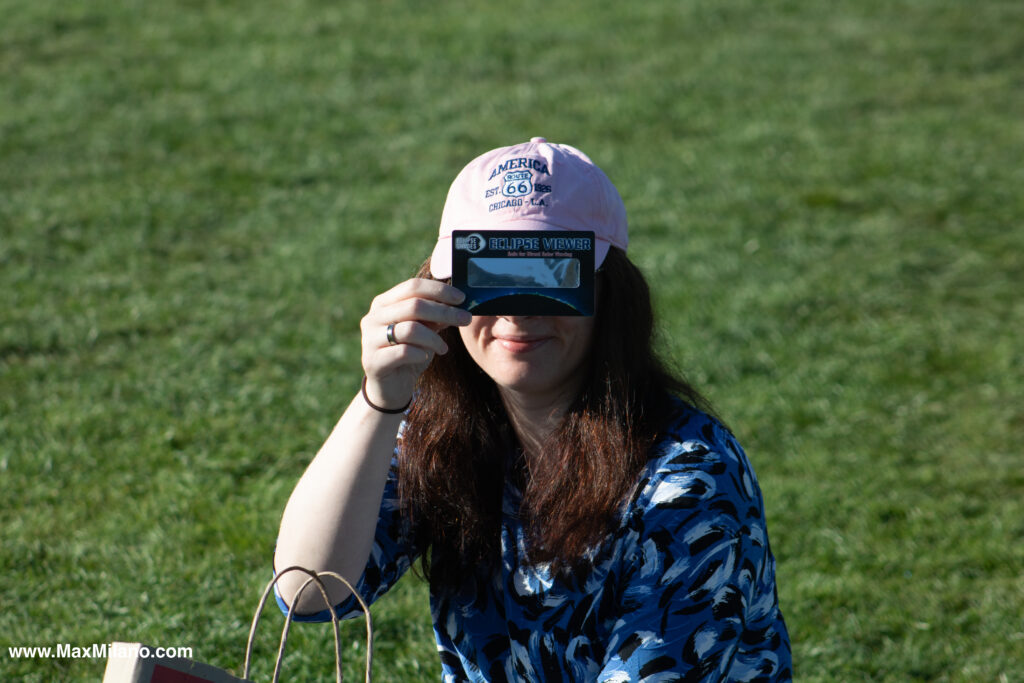
Choose your primary site and at least two backups, all comfortably inside the path of totality. Check the west-northwestern horizon, road access, parking restrictions and potential wildfire closures. Do not assume that remote mountain roads or protected natural areas will remain open.
Download offline maps, carry water and fuel, and expect severe traffic both before and after totality. Arrive several hours early, possibly much earlier at famous viewpoints.
During the final week, monitor AEMET and compare several forecast models. On eclipse day, examine satellite imagery, not merely the weather icon for the nearest city. Because the Sun will be so low, a bank of cloud many kilometers to the west can block it even when the sky directly overhead is perfectly blue.
Finally, do not spend the entire eclipse staring at a camera.
Take your photographs, but give yourself time to look around. Watch the horizon darken. Notice the changing light, the falling temperature and the behaviors of animals and people around you.
Totality will last little more than a minute in much of Spain. It will feel like ten seconds.
Then the Sun will return, and if this eclipse affects you the way my first one affected me, you will immediately begin planning for the next one.
Max Milano is a travel writer and photographer based in Los Angeles, California, and Valencia, Spain. His latest photography book, Mexico City Noir, Life Under The Volcanoes, is Available on Amazon. His photographs are available at MaxMilanoPix.